Home / Topics / Communications
Communications · How-to
Emergency alerts and NOAA Weather Radio
How official warnings reach you, and how to make sure they do.
Wireless Emergency Alerts (WEA)
- Short emergency messages that authorities send to WEA-enabled phones in a targeted area.[1]
- Free, with no sign-up. You aren’t charged, and there’s nothing to subscribe to.[1]
- They look like a text but have a unique sound and vibration, repeated twice.[1]
- They aren’t affected by network congestion.[1][2]
- WEA doesn’t track you. Alerts are broadcast from cell towers to every device in the area.[2]
- Not getting them? Check your phone’s settings. Some carriers call them “Government Alerts” or “Emergency Alert Messages,” and some phones need WEA turned on.[1]
Local alert sign-ups
WEA messages are very short. Local agencies may offer separate sign-ups for calls, texts, or emails with more detail, and the two work together.[2] Be Ready Utah says to check with your local emergency management office.[3] In Washington County, see Southern Utah.
NOAA Weather Radio
NOAA Weather Radio All Hazards is a nationwide network of radio stations broadcasting continuous weather information from the nearest National Weather Service office, 24 hours a day. It also carries non-weather emergencies through the Emergency Alert System.[1] Some emergency radios have an alert setting that turns the radio on automatically for an alert.[3] See NWS: NOAA Weather Radio for stations near you.
Emergency Alert System (EAS)
EAS alerts go out over broadcast TV and radio, satellite, and cable. It is also used when all other ways of alerting the public are unavailable.[1]
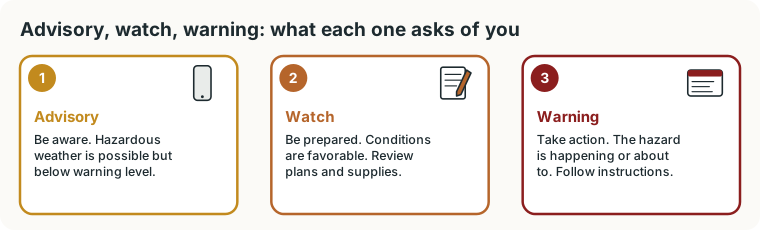
Watch vs. warning
| Term | What it means (NWS via Be Ready Utah) |
|---|---|
| Watch | Be prepared. A hazard is possible. Its occurrence, location, and timing may still be uncertain. |
| Advisory | Be aware. Weather that causes significant inconvenience and could become life-threatening without caution. |
| Warning[3] | Take immediate action. The hazard is imminent or already happening. |
Apps
The free Red Cross Emergency app gives preparedness guides and National Weather Service alerts.[5] The FEMA app can send weather alerts from the National Weather Service for up to five locations.[6]
Sources
- FEMA / Ready.gov: Emergency Alerts
- NOAA National Weather Service: Wireless Emergency Alerts
- Utah DEM / Be Ready Utah: Communication (12 Areas)
- NOAA National Weather Service: NOAA Weather Radio
- American Red Cross: Mobile Apps
- FEMA / Ready.gov: Get Tech Ready
Official pages checked 14 November 2026. Guidance changes; follow your local officials first. How we research.
Page checked on · Change log · Report an error · Calm by design