Topic hub · Complete guide
Shelter in place: when to stay and how to do it
Sometimes the safest place is inside. Ready.gov says sheltering is appropriate when conditions require protection in your home, at work, or elsewhere, and that in all cases you should stay informed and follow local authorities.[1]
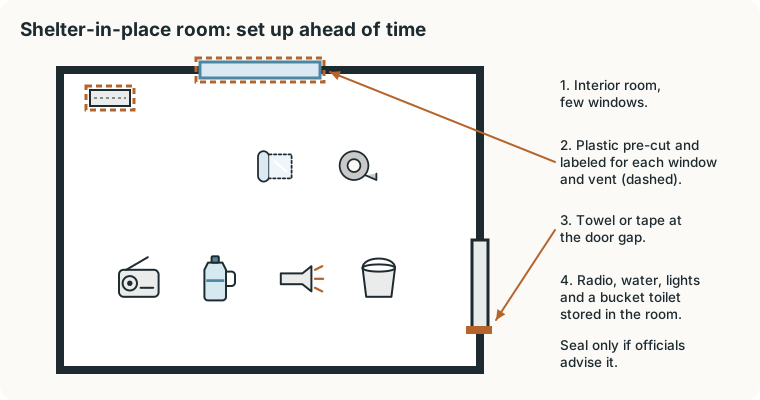
What
Ready.gov describes three kinds of sheltering:[1]
| Type | What it means |
|---|---|
| Stay at home | Staying home through an emergency with your own supplies. |
| Mass care shelter | A public shelter that provides life-sustaining services. Bring your kit. |
| Shelter in place | Going inside and staying there, often in an interior room, sometimes sealed, until officials say it is safe. |
Why
For some hazards, going outside is the danger. In a radiation emergency, CDC says the walls of your home can block much of the harmful radiation.[2]
When
- When officials tell you to.[1]
- If you see large amounts of debris in the air or authorities say the air is badly contaminated.[1]
- Tornado warnings can mean a short shelter; others last longer.[1]
How
How to seal a room
Plastic, tape, ventilation off.
How-toClean-air room for smoke
Air cleaner, MERV 13, N95.
Kit guideShelter-in-place room kit
Everything for the room.
Kit guideHome 72-hour bin
The Ready.gov basic kit.
ScenarioChemical release
Step by step.
ScenarioRadiation alert
Get inside, stay inside, stay tuned.
FAQShelter in place FAQ
Common questions.
Where
| Hazard | Room officials recommend |
|---|---|
| General / contaminated air[1] | Interior room with few windows (Ready.gov) |
| Chemical release[3] | Above-ground room with as few openings as possible (Ready.gov) |
| Radiation[2] | Basement or the middle of the building, away from walls and roof (CDC) |
| Wildfire smoke[4] | A room you can close off, with a portable air cleaner (Ready.gov, EPA) |
Chemicals and radiation call for different rooms. Follow the official guidance for each hazard.
Official guidance
- Ready.gov: Shelter
- Ready.gov: Chemical Emergencies
- Red Cross: Chemical Emergency
- CDC: Stay Inside
- EPA: Wildfires and Indoor Air Quality
Sources
- FEMA / Ready.gov: Shelter
- CDC: What to Do: Get Inside
- FEMA / Ready.gov: Chemical Emergencies
- FEMA / Ready.gov: Wildfires
- American Red Cross: Chemical Emergency
- CDC: What to Do: Stay Inside
- U.S. EPA: Wildfires and Indoor Air Quality
Official pages checked 14 November 2026. Guidance changes; follow your local officials first. How we research.
Page checked on · Change log · Report an error · Calm by design