Topic hub · Complete guide
Emergency water: the complete guide
After a disaster, clean drinking water may not be available. Your regular supply could be cut off or contaminated.[1] This guide covers what to store, why, when, how much, where, and how to make questionable water safe.
Short version: store at least 1 gallon per person per day, for at least 3 days and ideally 2 weeks[2]. Replace water you bottle yourself every 6 months[2]. If you must treat water, boiling is best[3], and bleach is the backup.
What counts as emergency water
- Stored water: unopened commercially bottled water, which CDC calls the safest and most reliable emergency source[2], plus water you bottle yourself in clean food-grade containers.
- Reserve water already in your home, like your water heater, pipes, and ice (EPA). See emergency sources at home.
- Treated water from a questionable source, made safe by boiling, disinfecting, or another method.
Why it matters
A normally active person needs about three quarters of a gallon of fluid a day, and that varies with age, health, activity, diet, and climate.[1] Contaminated water can carry germs that cause diseases such as dysentery, cholera, typhoid, and hepatitis.[1] Be Ready Utah calls disease outbreak “the second emergency” after a disaster.[5]
When to store, rotate, and treat
- Store now. Start with 3 days and build to 2 weeks (CDC). Be Ready Utah sets a minimum 2-week supply, which is 14 gallons per person.[6]
- Rotate water you bottled yourself every six months[1], and watch the expiration date on store-bought water.
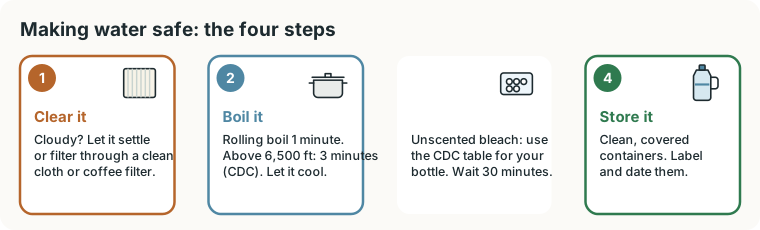
- Treat any water of uncertain quality before using it for drinking, food prep, dishes, brushing teeth, or ice.[1] Follow any boil-water or do-not-drink notice from your local officials.[3]
How much
At least one gallon per person per day.[1] Store more for children, nursing mothers, sick people, pregnant women, pets, and hot climates. In very hot temperatures, water needs can double.[1][2] Our water calculator does the math for your household.
Where to keep it
Keep it somewhere cool and dark. CDC suggests 50–70°F, out of direct sunlight, and away from gasoline, pesticides, and other toxic substances.[2] Ready.gov says to keep store-bought water sealed in its original container in a cool, dark place.[1]
How to make water safe
| Method | Kills germs | Removes chemicals/metals/salts | Guide |
|---|---|---|---|
| Boiling[1] | Yes | No | How to boil water |
| Bleach (chlorination) | Yes (less effective on some parasites) | No | Bleach amounts by strength |
| Distillation | Yes | Yes | Distillation |
| Filters, tablets, UV, sunlight | Partly; see guide | Varies | Other methods |
Water guides
Water storage basics
How much, containers, storing and rotating.
How-toHow to boil water
Boil times by agency, including altitude.
How-toDisinfect water with bleach
Exact amounts by bleach strength from CDC, EPA, and Ready.gov.
How-toFilters, tablets, and other methods
Pore sizes, iodine, distillation, UV, and sunlight.
How-toEmergency water sources at home
Ice, water heater, pipes, and what never to use.
How-toClean and fill containers
Sanitize, fill, label, rotate.
Free toolWater storage calculator
Your household’s number in gallons.
FAQWater FAQ
Answers to the most common water questions.
Official guidance
- Ready.gov: Water
- CDC: How to Make Water Safe in an Emergency
- EPA: Emergency Disinfection of Drinking Water
- Be Ready Utah: Water
Sources
- FEMA / Ready.gov: Water
- CDC: How to Create an Emergency Water Supply
- CDC: How to Make Water Safe in an Emergency
- U.S. EPA: Emergency Disinfection of Drinking Water
- Utah DEM / Be Ready Utah: Hygiene & Sanitation (12 Areas)
- Utah DEM / Be Ready Utah: Water (12 Areas)
Official pages checked 14 November 2026. Guidance changes; follow your local officials first. How we research.
Page checked on · Change log · Report an error · Calm by design