Home / Topics / Food and nutrition
Food and nutrition · Guide
Long-term food storage: the basic staples
A deeper pantry, built from foods you already eat, a little at a time.
What this covers
The basic staples Be Ready Utah lists for a longer home food supply, how to build them up, and how to store them so they last. It builds on the two-week food supply.
Why
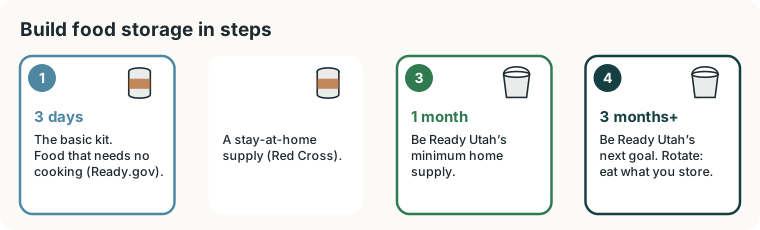
Be Ready Utah says to store at least a one-month food supply at home and work toward three months[1], and notes that food storage for 6 months to a year or longer is recommended.[1] You can only last up to three or four weeks without proper nutrition.[1]
The basic staples (Be Ready Utah)
| Group | Examples | Why |
|---|---|---|
| Grains | Wheat, rice, barley, millet, corn, oats, popcorn | The foundation of many food storage plans. |
| Legumes | Dry beans, peas, lentils | Combine with grains for a complete protein. |
| Fats and oils | Cooking oils; shortening (longer shelf life) | Energy and nutrient absorption. |
| Milk | Powdered milk; shelf (UHT) milk | Protein and vitamins. |
| Sugars | White or brown sugar, honey, molasses, corn syrup | Flavor; works with leavening in baking. |
| Salt | Salt (iodized has added iodine) | Health, recipes, and preserving. |
| Leavening | Yeast, baking soda, baking powder | Breads, biscuits, and most baked goods. |
| Flavor | Spices, seasonings, bouillon | Makes plain staples into meals. |
| Multivitamins | A multivitamin | Helps fill nutrition gaps. |
Be Ready Utah adds that you can’t just store 1,000 pounds of wheat and call it done; you need different kinds of food to stay healthy.[1]
How to build it
- Make a one-month menu from foods your family already eats, and stock what it takes.[1]
- Eat what you store and store what you eat, so food rotates and nothing is wasted.[1]
- Build gradually on a budget. Don’t go into debt to prepare.[1]
- Buy in steps, not all at once, so items don’t all expire together.[1]
- Store it cool, dark, and dry, off floors and walls. Every 18 °F above the ideal 40–70 °F halves shelf life.[1]
Safety notes
- Storing fresh eggs in petroleum jelly is not a safe method.[1]
- Home canning: use tested recipes only. See home canning safety.
- Oxygen absorbers are for dry foods with 10% moisture or less.[1]
Plan quantities
Use the food storage calculator to turn your household size into person-days and meals for each target.
Sources
- Utah DEM / Be Ready Utah: Food (12 Areas)
Official pages checked 14 November 2026. Guidance changes; follow your local officials first. How we research.
Page checked on · Change log · Report an error · Calm by design