Kit guide · First aid and medical
First aid kits for home, car, and hiking: the Red Cross supply list
The Red Cross supply list for a family of four, with exact quantities.
Supplies only, no treatment advice. This page lists what goes in a kit, from the Red Cross. How to use it to treat injuries is waiting for qualified review, so we point to training instead. Take a Red Cross first aid class. Bleeding-control, wound-closure, and prescription-medication content is not published.
How to use this guide: follow the steps, tick off the checklist, then print it . The printout has no shopping links.
Stay-Go Guide · First aid kits for home, car, and hiking: the Red Cross supply list · Checked: ____________
What to do
- Keep three kits: one at home, one in each car, and a small one you carry. The Red Cross says to keep a kit in your home and car and to carry one with you or know where to find one.[1] Some kits are made for activities like hiking or camping.[1]
- Buy a kit or make one from the Red Cross list below.[1]
- Add personal items such as your medications and emergency phone numbers, or items your health care provider suggests.[1] For an emergency supply of prescriptions, talk to your doctor or pharmacist.
- Check it regularly. Check expiration dates and replace used or out-of-date items.[1]
- Get trained. A kit is only as good as the person using it.
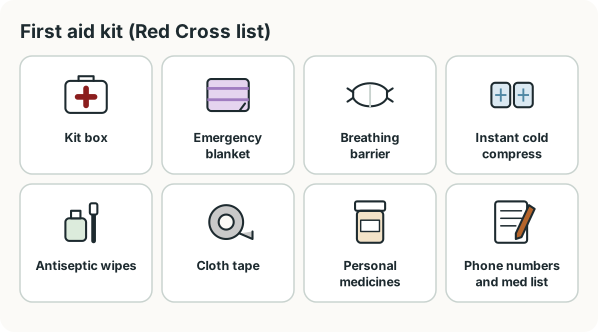
The checklist
Quantities come from the source cited beside them. † marks our packing suggestion where the official list gives no number.
| Item | How many | Why | |
|---|---|---|---|
| Absorbent compress dressings (5 × 9 in) | 2[1] | Red Cross list. | |
| Adhesive bandages, assorted sizes | 25[1] | Red Cross list. | |
| Adhesive cloth tape (10 yd × 1 in) | 1[1] | Red Cross list. | |
| Antibiotic ointment packets (about 1 g) | 5[1] | Red Cross list. | |
| Antiseptic wipe packets | 5[1] | Red Cross list. | |
| Aspirin packets (81 mg each) | 2[1] | On the Red Cross list. We give no guidance on when to use any medicine; ask a doctor. | |
| Emergency blanket | 1[1] | Red Cross list. | |
| Breathing barrier with one-way valve | 1[1] | Red Cross list. Learn to use it in a CPR class. | |
| Instant cold compress | 1[1] | Red Cross list. | |
| Non-latex gloves, size large | 2 pairs[1] | Red Cross list. | |
| Hydrocortisone ointment packets (about 1 g) | 2[1] | Red Cross list. | |
| Gauze roller bandage, 3 in | 1[1] | Red Cross list. | |
| Roller bandage, 4 in wide | 1[1] | Red Cross list. | |
| Sterile gauze pads, 3 × 3 in | 5[1] | Red Cross list. | |
| Sterile gauze pads, 4 × 4 in | 5[1] | Red Cross list. | |
| Oral thermometer (non-mercury, non-glass) | 1[1] | Red Cross list. | |
| Triangular bandages | 2[1] | Red Cross list. | |
| Tweezers | 1[1] | Red Cross list. | |
| First aid instruction booklet | 1[1] | Red Cross list. |
Car and hiking kits
Use the same list, sized down for a hiking pack. Be Ready Utah’s everyday-carry list includes a pocket first aid kit with adhesive bandages, non-latex gloves, alcohol pads, and a rescue breathing barrier, plus personal medications and medical and allergy information.[2]
Build it on a budget
Ready.gov suggests building a kit over time, starting with what you already have, and checking garage sales and thrift stores.[3] Tiers add up: each one builds on the one before. Dollar amounts are rough planning targets, not price quotes; prices vary.
$0 (Free: gather from home)
- Gather bandages and supplies you already own into one box
$50
- Basic supplies from the Red Cross list
$150
- A home kit and a car kit
- A first-aid class (often free or discounted)
Shop this list
Affiliate disclosure: the shopping links below are Amazon affiliate links. As an Amazon Associate we earn from qualifying purchases, at no extra cost to you. They are generic search links, not endorsements of a brand. Full disclosure.
These are generic Amazon searches, not picks of a specific brand. Compare ratings, check what fits your household, and buy only what you don’t already own. Most of this list can come from around your home.
- Adhesive bandages, assorted sizes (Amazon)
- Adhesive cloth tape (10 yd × 1 in) (Amazon)
- Antiseptic wipe packets (Amazon)
- Emergency blanket (Amazon)
- Breathing barrier with one-way valve (Amazon)
- Instant cold compress (Amazon)
- Non-latex gloves, size large (Amazon)
- Gauze roller bandage, 3 in (Amazon)
- Sterile gauze pads, 3 × 3 in (Amazon)
- Sterile gauze pads, 4 × 4 in (Amazon)
- Oral thermometer (non-mercury, non-glass) (Amazon)
- Triangular bandages (Amazon)
- Tweezers (Amazon)
- First aid instruction booklet (Amazon)
Sources
- American Red Cross: Anatomy of a First Aid Kit
- Utah DEM / Be Ready Utah: Get a Kit: Family
- FEMA / Ready.gov: Low and No Cost Preparedness
Official pages checked 14 November 2026. Guidance changes; follow your local officials first. How we research.
Page checked on · Change log · Report an error · Calm by design