Kit guide · Family and pets
Kids and infant emergency kit
Kids need their own kit. Babies need theirs updated every few months.
How to use this guide: follow the steps, tick off the checklist, then print it . The printout has no shopping links.
Stay-Go Guide · Kids and infant emergency kit · Checked: ____________
What to do
- Give each child their own kit. Be Ready Utah says infant and child kits need to be different from adult kits.[1]
- Update baby kits often. For ages 0 to 2, Be Ready Utah says update every 2 to 3 months, and pack clothes one size larger than the child wears now.[1]
- Plan for school. Know your school or daycare’s emergency plan and who can pick your child up. Ready.gov’s plan steps include school and daycare.[2]
- Practice with them. Show kids the kit and the meeting place. The Red Cross has free kids’ preparedness programs and videos.[3]
- Help them cope afterward. See Ready.gov’s guidance on helping children cope.
The checklist
Quantities come from the source cited beside them. † marks our packing suggestion where the official list gives no number.
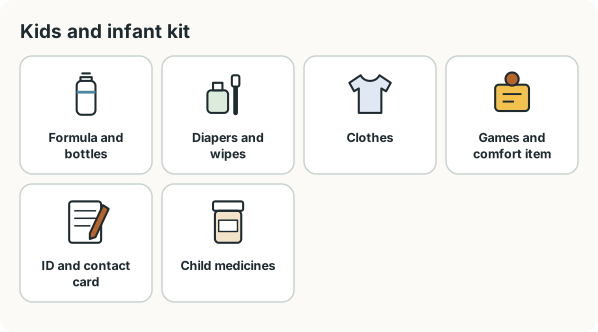
| Item | How many | Why | |
|---|---|---|---|
| Infant formula, bottles, baby food | Several days† | Ready.gov and Red Cross lists.[5][6] | |
| Diapers, wipes, diaper rash cream | Several days† | Ready.gov.[5] | |
| Change of clothes, one size up | 1–2 sets | Be Ready Utah.[1] | |
| Books, games, puzzles, comfort item | A few | Ready.gov and Red Cross.[5] | |
| Contact card with parents’ numbers and out-of-area contact | 1 per child | Red Cross: family and emergency contact information.[6] | |
| Child’s medications and medical info | Per doctor | Ask your pediatrician about an emergency supply. | |
| Small backpack | 1 per child† | Be Ready Utah: a separate kit for each family member.[1] | |
| Water and snacks they will eat | 3 days | Red Cross 3-day evacuation supply.[6] | |
| Flashlight and whistle | 1 each | Ready.gov basic list.[5] |
Build it on a budget
Ready.gov suggests building a kit over time, starting with what you already have, and checking garage sales and thrift stores.[7] Tiers add up: each one builds on the one before. Dollar amounts are rough planning targets, not price quotes; prices vary.
$0 (Free: gather from home)
- Change of clothes one size up
- Comfort toy or book
- Contact card for each child
$50
- Diapers and wipes
- Snacks the kids eat
$150
- Formula or baby food supply (ask your pediatrician)
- Child-sized masks and blanket
$500
- Full kit for each child, updated as they grow
Shop this list
Affiliate disclosure: the shopping links below are Amazon affiliate links. As an Amazon Associate we earn from qualifying purchases, at no extra cost to you. They are generic search links, not endorsements of a brand. Full disclosure.
These are generic Amazon searches, not picks of a specific brand. Compare ratings, check what fits your household, and buy only what you don’t already own. Most of this list can come from around your home.
Sources
- Utah DEM / Be Ready Utah: Get a Kit: Family
- FEMA / Ready.gov: Make a Plan
- American Red Cross: Teaching Kids about Emergency Preparedness
- FEMA / Ready.gov: Helping Children Cope
- FEMA / Ready.gov: Build A Kit
- American Red Cross: Survival Kit Supplies
- FEMA / Ready.gov: Low and No Cost Preparedness
Official pages checked 14 November 2026. Guidance changes; follow your local officials first. How we research.
Page checked on · Change log · Report an error · Calm by design