Kit guide · Communications
Radio communications setup: license-free, GMRS, and ham options
Phones can fail in a disaster. Radios can keep your family in touch, as long as you use them legally.
Read this before you buy a handheld radio. The FCC says operating a transmitter that requires a license without one can bring fines, imprisonment, or confiscation of equipment.[1] Two key rules:
- Ham (amateur) bands need an amateur license. Even if a radio works only on amateur frequencies, the FCC says the operator must have an amateur license.[2]
- Many low-cost handhelds aren’t legal on FRS or GMRS. The FCC warned in 2018 that many low-cost two-way VHF/UHF radios sold online don’t comply with its rules, and some can transmit on public-safety channels.[2] An FRS radio must be FCC-certified and may not be modified,[3] so a ham handheld isn’t a legal way onto FRS channels. Before you buy, the FCC says to make sure a radio is either labeled FCC-compliant or operates only within amateur frequencies.[2]
This is a summary of FCC guidance, not legal advice. Check current rules on the FCC pages cited below.
How to use this guide: follow the steps, tick off the checklist, then print it . The printout has no shopping links.
Stay-Go Guide · Radio setup (Option A: license-free) · Checked: ____________
What to do
- Start with listening, which needs no license. Get a NOAA Weather Radio. It broadcasts weather and other emergency information around the clock from the nearest Weather Service office.[4]
- Choose your path. License-free: FRS radios, which anyone can use regardless of age.[3] Family license: GMRS, one FCC license that covers your family.[5] Exam license: amateur (ham) radio, with the longest reach.[6]
- License first, then buy. For GMRS you must be 18 or older, and licenses run 10 years.[5] For ham radio, pass an exam given by volunteer examiners. Most people start at Technician class, and the question pools are public.[7]
- Buy certified gear for the service you’ll use, and check for the FCC label.[2] Program only channels you’re allowed to use.
- Practice with your family. Pick a channel and check-in times, and write them on your family plan. Expect less range than the box says: Be Ready Utah warns that in mountains or cities, advertised ranges can drop to a mile or less.[6]
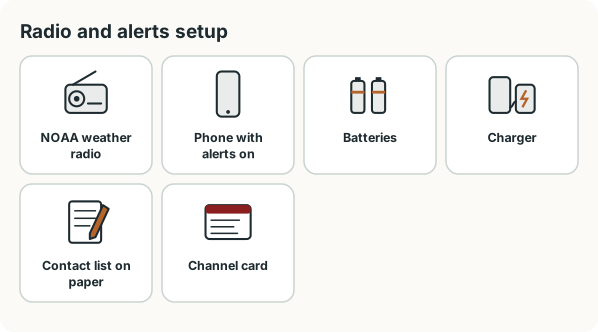
The checklist
Quantities come from the source cited beside them. † marks our packing suggestion where the official list gives no number.
| Item | How many | Why | |
|---|---|---|---|
| NOAA Weather Radio with tone alert | 1 per household | Receive-only. On Ready.gov’s basic kit list.[8] | |
| FRS two-way radios | 1 per family member† | No license needed. 22 channels shared with GMRS.[3] Range is usually under half a mile on channels 8–14, longer on the others depending on conditions.[3] | |
| Rechargeable batteries and charger | 1 set per radio† | So radios work through a long outage. Charge them from a power bank or the car. | |
| Power bank | 1† | Ready.gov lists a backup battery for phones.[8] Many radios charge by USB too. |
Nice to have (not on the official lists)
Optional extras we think are useful. They are our suggestions, not agency recommendations.
| Item | How many | Why | |
|---|---|---|---|
| GMRS radio (FCC-certified for GMRS) | 1 per family member, after you hold a license | One license covers your family. GMRS range runs from one to 25 miles depending on the station, terrain, and repeaters.[5] | |
| Technician license study guide | 1 | The license comes first.[7] | |
| Dual-band amateur handheld (Baofeng-style or similar) | 1 per licensed operator | Only once you’re licensed, and only a model labeled FCC-compliant or limited to amateur frequencies.[2] | |
| Upgraded handheld antenna | 1 per radio† | The stock antenna on budget handhelds is often the weakest part. Make sure the connector matches your radio. | |
| Spare battery pack | 1 per radio† | Lets you swap and keep talking while one charges. | |
| Programming cable | 1 | Lets you load your local repeaters and stay on frequencies you’re licensed for. |
Option B: GMRS (one license for the family)
| Item | How many | Why | |
|---|---|---|---|
| GMRS radio (FCC-certified for GMRS) | 1 per family member, after you hold a license | One license covers your family. GMRS range runs from one to 25 miles depending on the station, terrain, and repeaters.[5] |
Option C: ham radio (license by exam)
| Item | How many | Why | |
|---|---|---|---|
| Technician license study guide | 1 | The license comes first.[7] | |
| Dual-band amateur handheld (Baofeng-style or similar) | 1 per licensed operator | Only once you’re licensed, and only a model labeled FCC-compliant or limited to amateur frequencies.[2] | |
| Upgraded handheld antenna | 1 per radio† | The stock antenna on budget handhelds is often the weakest part. Make sure the connector matches your radio. | |
| Spare battery pack | 1 per radio† | Lets you swap and keep talking while one charges. | |
| Programming cable | 1 | Lets you load your local repeaters and stay on frequencies you’re licensed for. |
More detail in our two-way radio guide and the FCC pages: FRS, GMRS, Amateur Radio Service.
Build it on a budget
Ready.gov suggests building a kit over time, starting with what you already have, and checking garage sales and thrift stores.[9] Tiers add up: each one builds on the one before. Dollar amounts are rough planning targets, not price quotes; prices vary.
$0 (Free: gather from home)
- Turn on phone emergency alerts
- Write down an out-of-area contact
$50
- A pair of FRS radios (no license)
- Batteries
$150
- NOAA weather radio with tone alert
$500
- GMRS radios (FCC license required first)
Shop this list
Affiliate disclosure: the shopping links below are Amazon affiliate links. As an Amazon Associate we earn from qualifying purchases, at no extra cost to you. They are generic search links, not endorsements of a brand. Full disclosure.
These are generic Amazon searches, not picks of a specific brand. Compare ratings, check what fits your household, and buy only what you don’t already own. Most of this list can come from around your home.
- NOAA Weather Radio with tone alert (Amazon)
- FRS two-way radios (Amazon)
- Rechargeable batteries and charger (Amazon)
- Power bank (Amazon)
- GMRS radio (FCC-certified for GMRS) (Amazon)
- Technician license study guide (Amazon)
- Dual-band amateur handheld (Baofeng-style or similar) (Amazon)
- Upgraded handheld antenna (Amazon)
- Spare battery pack (Amazon)
- Programming cable (Amazon)
Sources
- Federal Communications Commission: Personal Radio Services
- Federal Communications Commission: Enforcement Advisory 2018-03: Two-way VHF/UHF radios (DA 18-980)
- Federal Communications Commission: Family Radio Service (FRS)
- FEMA / Ready.gov: Emergency Alerts
- Federal Communications Commission: General Mobile Radio Service (GMRS)
- Utah DEM / Be Ready Utah: Communication (12 Areas)
- Federal Communications Commission: Amateur Radio Service
- FEMA / Ready.gov: Build A Kit
- FEMA / Ready.gov: Low and No Cost Preparedness
Official pages checked 14 November 2026. Guidance changes; follow your local officials first. How we research.
Page checked on · Change log · Report an error · Calm by design