Kit guide · Shelter in place
Shelter-in-place room kit
A bag in your chosen room so sealing it takes minutes, not an hour.
How to use this guide: follow the steps, tick off the checklist, then print it . The printout has no shopping links.
Stay-Go Guide · Shelter-in-place room kit · Checked: ____________
What to do
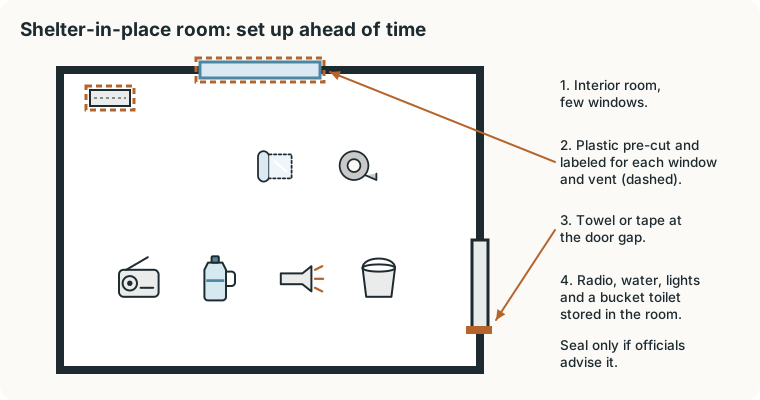
- Pick the room now. Ready.gov says an interior room with few windows.[1] For a chemical release, Ready.gov says an above-ground room with as few openings as possible.[2] For radiation, CDC says the basement or middle of the building.[3] Different hazards, different rooms: follow officials.
- Cut the plastic ahead of time. Ready.gov: measure and cut sheeting in advance, several inches wider than each opening, and label each sheet.[1]
- Store the kit in or near that room.
- When told to shelter in place: lock doors, close windows, vents, and fireplace dampers, and turn off fans, air conditioning, and forced-air heat.[1]
- Seal the room if officials advise it: tape the plastic at the corners first, then all edges.[1] Listen to the radio for instructions.[4]
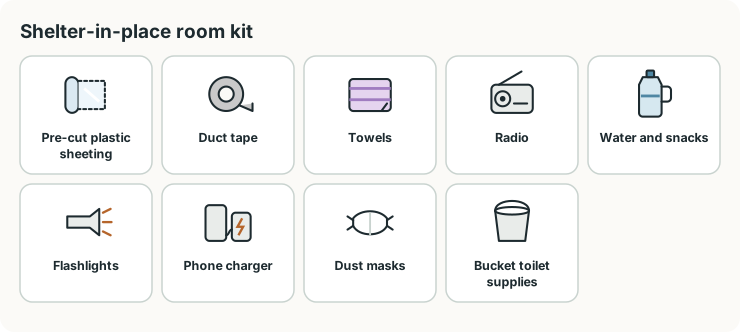
The checklist
Quantities come from the source cited beside them. † marks our packing suggestion where the official list gives no number.
| Item | How many | Why | |
|---|---|---|---|
| Plastic sheeting (pre-cut and labeled) | Enough for each window, door, and vent in the room | Ready.gov basic kit and shelter guidance.[5] | |
| Duct tape | 2 rolls or more† | For sealing.[1] | |
| Scissors | 1 | Ready.gov basic kit.[5] | |
| Towels | Several | Ready.gov: seal gaps with wet towels, plastic, tape, wax paper, or foil.[2] | |
| Battery or hand-crank radio | 1 | To stay tuned.[6] | |
| Water and snacks | At least 1 day | CDC says staying inside for at least 24 hours can protect you in a radiation emergency.[7] | |
| Flashlight and batteries | 1 per person | Ready.gov.[8] | |
| Phone charger or power bank | 1 | Ready.gov basic kit.[5] | |
| Dust masks | 1 per person | Ready.gov basic kit.[5] | |
| Bucket toilet supplies | 1 set | If you may be inside for a while. See the toilet kit. |
Build it on a budget
Ready.gov suggests building a kit over time, starting with what you already have, and checking garage sales and thrift stores.[9] Tiers add up: each one builds on the one before. Dollar amounts are rough planning targets, not price quotes; prices vary.
$0 (Free: gather from home)
- Choose a room
- Gather tape, towels, and plastic you own
- Water and snacks in the room
$50
- Plastic sheeting and duct tape
$150
- Battery radio
- Extra water and snacks for the room
Shop this list
Affiliate disclosure: the shopping links below are Amazon affiliate links. As an Amazon Associate we earn from qualifying purchases, at no extra cost to you. They are generic search links, not endorsements of a brand. Full disclosure.
These are generic Amazon searches, not picks of a specific brand. Compare ratings, check what fits your household, and buy only what you don’t already own. Most of this list can come from around your home.
Sources
- FEMA / Ready.gov: Shelter
- FEMA / Ready.gov: Chemical Emergencies
- CDC: What to Do: Get Inside
- American Red Cross: Chemical Emergency
- FEMA / Ready.gov: Build A Kit
- CDC: What to Do: Stay Tuned
- CDC: What to Do: Stay Inside
- FEMA / Ready.gov: Power Outages
- FEMA / Ready.gov: Low and No Cost Preparedness
Official pages checked 14 November 2026. Guidance changes; follow your local officials first. How we research.
Page checked on · Change log · Report an error · Calm by design