Kit guide · Light and power
Power outage kit: lights, charging, food, and CO safety
Everything for a blackout in one bin, so the first ten minutes are calm.
How to use this guide: follow the steps, tick off the checklist, then print it . The printout has no shopping links.
Stay-Go Guide · Power outage kit: lights, charging, food, and CO safety · Checked: ____________
What to do
- List everything you need that runs on electricity, then plan batteries or other backup power for each.[1]
- Talk to your medical provider about a plan for powered medical devices and refrigerated medicines.[1]
- Install CO alarms with battery backup in central locations on every level of your home.[1]
- Store food and water. The Red Cross says at least two weeks for home.[2] See the outage checklist for what to do when the lights go out.
- Keep it together in one bin in a spot everyone can find in the dark, with a flashlight on top.
The checklist
Quantities come from the source cited beside them. † marks our packing suggestion where the official list gives no number.
| Item | How many | Why | |
|---|---|---|---|
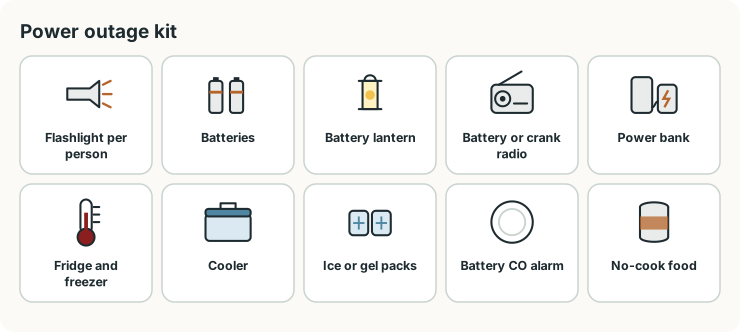
| Flashlights | 1 per person[1] | Use flashlights, not candles.[2] | |
| Extra batteries | For every device† | Ready.gov basic kit item.[3] | |
| Power bank or portable charger | 1 per phone† | Ready.gov names a portable charger or power bank.[1] | |
| Battery or hand-crank radio | 1 | The Red Cross lists a crank or battery radio and a non-cordless home phone.[2] | |
| CO alarms with battery backup | 1 per level | Ready.gov: every level of your home.[1] | |
| Smoke alarms with battery backup | Every floor, inside and outside sleeping areas | Red Cross, test monthly.[2] | |
| Cooler and ice | 1 or more† | To extend refrigeration.[2] | |
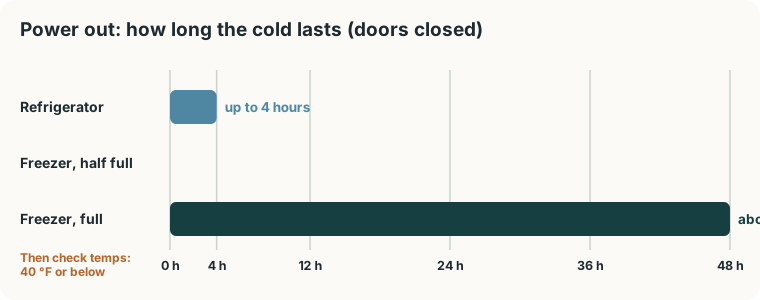
| Appliance thermometers | 1 each for fridge, freezer, and cooler | The Red Cross says to monitor food temperature.[2] Throw out food at 40°F or warmer, especially dairy and meat.[2] | |
| Surge protectors | For key electronics | Red Cross: have current surge protectors.[2] | |
| Manual can opener | 1 | Ready.gov basic kit item.[3] | |
| Food and water | At least 2 weeks[2] | See the water kit and the food hub. | |
| Heavy-duty extension cords (only if you have a generator) | As needed | Ready.gov says to connect appliances to a generator with heavy-duty extension cords, and to run the generator outdoors at least 20 feet from windows, doors, and attached garages.[1] |
Nice to have (not on the official lists)
Optional extras we think are useful. They are our suggestions, not agency recommendations.
| Item | How many | Why | |
|---|---|---|---|
| Portable power station | 1 | Runs small devices silently indoors with no fumes. Size it with our runtime guide. | |
| Folding solar panel | 1 | Recharges a power station during a long outage. Read solar for emergencies first. | |
| Battery lanterns | 1 per room you’ll use | Lights a whole room, which is easier than holding a flashlight. |
Carbon monoxide kills. Never use a generator, camp stove, or charcoal grill indoors. Never heat your home with a gas stove or oven.[1] See carbon monoxide safety.
Build it on a budget
Ready.gov suggests building a kit over time, starting with what you already have, and checking garage sales and thrift stores.[4] Tiers add up: each one builds on the one before. Dollar amounts are rough planning targets, not price quotes; prices vary.
$0 (Free: gather from home)
- Flashlights from around the house
- Cooler and ice packs
- Paper list of utility numbers
- Charged phones
$50
- A flashlight per person
- Extra batteries
- Appliance thermometers
- Battery CO alarm if missing
$150
- Power bank per person
- Battery lanterns
- Battery or hand-crank radio
$500
- Portable power station sized with the runtime calculator
- Solar panel for recharging
Shop this list
Affiliate disclosure: the shopping links below are Amazon affiliate links. As an Amazon Associate we earn from qualifying purchases, at no extra cost to you. They are generic search links, not endorsements of a brand. Full disclosure.
These are generic Amazon searches, not picks of a specific brand. Compare ratings, check what fits your household, and buy only what you don’t already own. Most of this list can come from around your home.
- Flashlights (Amazon)
- Extra batteries (Amazon)
- Power bank or portable charger (Amazon)
- Battery or hand-crank radio (Amazon)
- CO alarms with battery backup (Amazon)
- Smoke alarms with battery backup (Amazon)
- Cooler and ice (Amazon)
- Appliance thermometers (Amazon)
- Surge protectors (Amazon)
- Manual can opener (Amazon)
- Heavy-duty extension cords (only if you have a generator) (Amazon)
- Portable power station (Amazon)
- Folding solar panel (Amazon)
- Battery lanterns (Amazon)
Sources
- FEMA / Ready.gov: Power Outages
- American Red Cross: Power Outage Safety
- FEMA / Ready.gov: Build A Kit
- FEMA / Ready.gov: Low and No Cost Preparedness
Official pages checked 14 November 2026. Guidance changes; follow your local officials first. How we research.
Page checked on · Change log · Report an error · Calm by design