Kit guide · Southern Utah hazards
Wildfire evacuation kit
Wildfires move fast. Pack for smoke and for leaving on short notice.
How to use this guide: follow the steps, tick off the checklist, then print it . The printout has no shopping links.
Stay-Go Guide · Wildfire evacuation kit · Checked: ____________
What to do
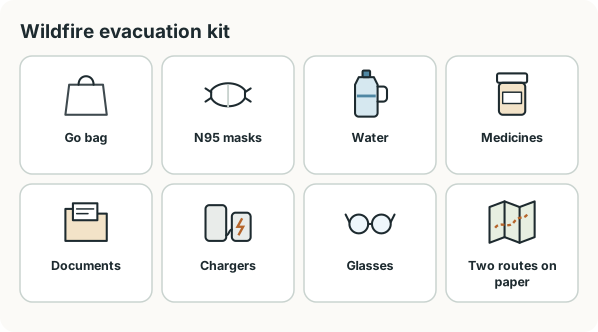
- Pack a go-kit and a stay-at-home kit. The Red Cross says 3 days of supplies you can carry, and 2 weeks if you stay home.[1] Start with a go bag for each person.
- Add smoke protection. Ready.gov says to store an N95 mask if available.[2]
- Know your routes. Have different escape routes from your home and community and practice them.[1] In Washington County, look up your zone with Genasys Protect.[3]
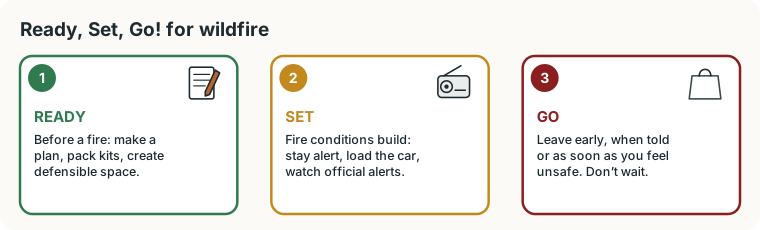
- Leave when told, or sooner if you feel in danger. Ready.gov: evacuate immediately if authorities tell you to.[2] The Red Cross: be ready to leave if authorities advise, or if you feel you are in danger.[1]
- If you can’t get out, call 911 and give your location, knowing response could be delayed. Turn on lights to help rescuers find you.[2]
The checklist
Quantities come from the source cited beside them. † marks our packing suggestion where the official list gives no number.
| Item | How many | Why | |
|---|---|---|---|
| N95 masks | Several per person† | Ready.gov and EPA.[2][4] | |
| Medications | Red Cross: 1-month supply in a child-proof container[1] | Talk to your doctor or pharmacist about an emergency supply. | |
| Personal, financial, and medical records | 1 set | Red Cross.[1] See the document kit. | |
| Backup phone battery | 1 per phone | Red Cross.[1] | |
| Long sleeves, long pants, sturdy shoes, hat | 1 set per person | Ready.gov evacuation clothing.[5] | |
| Pet go-kit | Per pet | See the pet go-kit. | |
| Garden hose long enough to reach around the house | 1 | Ready.gov: an outdoor water source with a hose that reaches any area of your property.[2] | |
| Portable air cleaner for one “clean room” | 1 | Ready.gov and EPA: a room closed off from outside air with a portable air cleaner.[2] EPA says make sure it doesn’t produce ozone.[4] | |
| MERV 13 HVAC filter (if your system takes one) | 1 spare | EPA: MERV 13 or as high as your system allows, fitted snugly.[4] |
Nice to have (not on the official lists)
Optional extras we think are useful. They are our suggestions, not agency recommendations.
| Item | How many | Why | |
|---|---|---|---|
| Box fan and furnace filter (DIY air cleaner) | 1 each | EPA describes DIY cleaners made by attaching a furnace filter to a box fan, but says commercial units with a known clean air delivery rate are typically preferred.[4] | |
| Goggles and work gloves for ash cleanup | 1 each | The Red Cross lists gloves, goggles, and an N95 for ash cleanup.[1] |
Build it on a budget
Ready.gov suggests building a kit over time, starting with what you already have, and checking garage sales and thrift stores.[6] Tiers add up: each one builds on the one before. Dollar amounts are rough planning targets, not price quotes; prices vary.
$0 (Free: gather from home)
- Go bag from home items
- Plan two routes out
- Copies of documents
$50
- N95 respirators
- Battery bank
$150
- Fire-resistant document pouch
- Battery radio
$500
- Portable air cleaner for smoke days
- Go bags for everyone
Shop this list
Affiliate disclosure: the shopping links below are Amazon affiliate links. As an Amazon Associate we earn from qualifying purchases, at no extra cost to you. They are generic search links, not endorsements of a brand. Full disclosure.
These are generic Amazon searches, not picks of a specific brand. Compare ratings, check what fits your household, and buy only what you don’t already own. Most of this list can come from around your home.
- N95 masks (Amazon)
- Personal, financial, and medical records (Amazon)
- Backup phone battery (Amazon)
- Garden hose long enough to reach around the house (Amazon)
- Portable air cleaner for one “clean room” (Amazon)
- MERV 13 HVAC filter (if your system takes one) (Amazon)
- Box fan and furnace filter (DIY air cleaner) (Amazon)
- Goggles and work gloves for ash cleanup (Amazon)
Sources
- American Red Cross: Wildfire Safety
- FEMA / Ready.gov: Wildfires
- Washington County, Utah: Evacuation Zones (Genasys Protect)
- U.S. EPA: Wildfires and Indoor Air Quality
- FEMA / Ready.gov: Evacuation
- FEMA / Ready.gov: Low and No Cost Preparedness
Official pages checked 14 November 2026. Guidance changes; follow your local officials first. How we research.
Page checked on · Change log · Report an error · Calm by design