Kit guide · Evacuation
Go bag: the complete evacuation backpack list
One bag per person, packed and by the door, so you can leave in minutes. Some people call it a bug-out bag. Officials call it a go-bag.
How to use this guide: follow the steps, tick off the checklist, then print it . The printout has no shopping links.
Stay-Go Guide · Go bag: the complete evacuation backpack list · Checked: ____________
What to do
- Pick one bag per person. Be Ready Utah says to keep a separate kit for each family member, in a backpack, wheeled suitcase, or other portable container.[1] Ready.gov says a go-bag should be something you can carry if you evacuate on foot or by public transportation.[2]
- Pack the checklist below. Put anything that can get wet in plastic bags. Ready.gov says airtight plastic bags.[3][1]
- Store it near an exit, in an easy-to-reach spot.[1] Make sure everyone knows where the bag is and who is responsible for grabbing it.[2]
- Keep the car ready too. Ready.gov says to keep at least a half tank of gas at all times, and a full tank if an evacuation seems likely.[2] Put the heavier extras in the car: see the car kit.
- Check it twice a year. Replace anything expired or broken.[1] Ready.gov also says to rethink your needs every year as your family changes.[3]
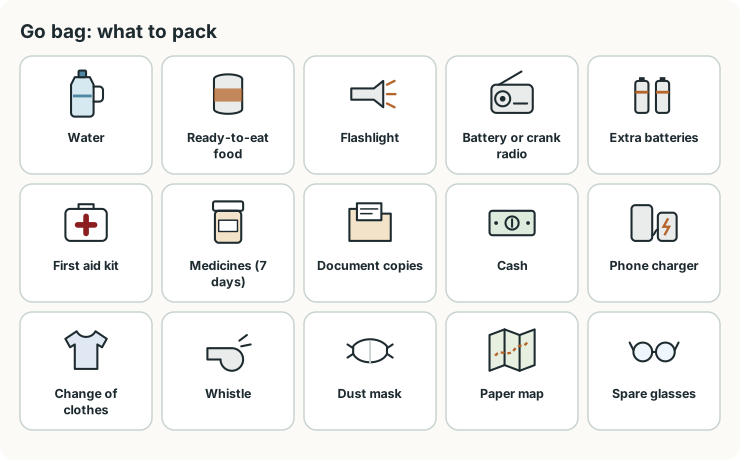
The checklist
Quantities come from the source cited beside them. † marks our packing suggestion where the official list gives no number.
| Item | How many | Why | |
|---|---|---|---|
| Backpack or wheeled bag | 1 per person | Something you can carry on foot.[1] | |
| Water | Red Cross: 1 gallon per person per day, 3-day supply for evacuation[4] | Water is the first item on every official list. Three gallons each is heavy, so carry what you can and keep the rest in the car. | |
| Food | 3-day supply, non-perishable and easy to prepare[4] | Pick foods that need no cooking or water. Add a manual can opener if you pack cans. | |
| Flashlight | 1 per person[5] | On both the Ready.gov and Red Cross lists.[3][4] | |
| Battery-powered or hand-crank radio | 1 per household† | Ready.gov lists a battery or hand-crank radio and a NOAA Weather Radio with tone alert.[3] | |
| Extra batteries | Enough for each device† | For the flashlight and radio.[3] | |
| First aid kit | 1† | On both lists. See the Red Cross contents in our first aid kit guide.[4] | |
| Medications and medical items | Red Cross: 7-day supply[4] | Talk to your doctor or pharmacist about an emergency supply. Include glasses or contact lens solution. | |
| Multi-purpose tool | 1† | Red Cross basic list.[4] | |
| Whistle | 1 per person† | To signal for help.[3] | |
| Dust masks | 1 or more per person† | Ready.gov: a dust mask helps filter contaminated air. The Red Cross suggests N95 or surgical masks.[3][4] | |
| Moist towelettes, garbage bags, plastic ties | A small pack of each† | For personal sanitation.[3] | |
| Hygiene items | 1 small kit per person† | Soap, hand sanitizer, and feminine and personal hygiene supplies.[3] | |
| Copies of important documents | 1 set | Medication list and medical information, proof of address, deed or lease, passports, birth certificates, insurance policies.[4] See the document kit. | |
| Phone charger and backup battery | 1 per phone† | Ready.gov lists a cell phone with chargers and a backup battery.[3] | |
| Contact list on paper | 1 per person | Family and emergency contact information.[4] Use the family plan worksheet. | |
| Cash in small bills | Some† | ATMs and card readers may not work.[6] | |
| Emergency blanket | 1 per person† | Red Cross basic list.[4] | |
| Local map | 1 | Roads may be closed and phones may be down.[3][4] | |
| Change of clothes and sturdy shoes | 1 set per person | Clothing for your climate.[3] Ready.gov says to evacuate in long pants, long sleeves, and a hat.[2] | |
| Spare car and house keys | 1 set | Red Cross extra item.[4] | |
| Rain gear and work gloves | 1 each per person† | The Red Cross suggests these depending on local hazards.[4] |
Nice to have (not on the official lists)
Optional extras we think are useful. They are our suggestions, not agency recommendations.
| Item | How many | Why | |
|---|---|---|---|
| Headlamp | 1 per person | Keeps both hands free. A flashlight still covers the official list. | |
| Two-way radios | 1 pair | The Red Cross lists two-way radios as an extra to consider.[4] See the radio setup guide for license rules. | |
| Water filter bottle | 1 per person | Not a replacement for stored water. Read our filter guide first: many filters don’t remove viruses. | |
| Paper and pencil | 1 | Ready.gov extra item.[3] |
Kids, pets, and medical needs
Add the kids and infant kit, the pet go-kit, and anything someone needs every day. Be Ready Utah says to personalize the kit: if you need something to be healthy and comfortable every day, try to put some of it in.[1]
Want this in one interactive list? Use the 72-hour kit checklist.
Build it on a budget
Ready.gov suggests building a kit over time, starting with what you already have, and checking garage sales and thrift stores.[7] Tiers add up: each one builds on the one before. Dollar amounts are rough planning targets, not price quotes; prices vary.
$0 (Free: gather from home)
- Backpack or duffel you own
- Water bottles filled from the tap
- Shelf-stable snacks from the cupboard
- Spare clothes and sturdy shoes
- Old phone charger and a flashlight
- Paper copy of contacts and documents
$50
- Battery bank for your phone
- Small first-aid supplies
- Extra batteries
- Masks and hand sanitizer
$150
- Hand-crank or battery radio
- Emergency blankets and rain poncho
- Water filter or purification tablets
$500
- A go bag per person
- Higher-capacity power bank
- Duplicate prescriptions and glasses (ask your doctor)
Shop this list
Affiliate disclosure: the shopping links below are Amazon affiliate links. As an Amazon Associate we earn from qualifying purchases, at no extra cost to you. They are generic search links, not endorsements of a brand. Full disclosure.
These are generic Amazon searches, not picks of a specific brand. Compare ratings, check what fits your household, and buy only what you don’t already own. Most of this list can come from around your home.
- Backpack or wheeled bag (Amazon)
- Water (Amazon)
- Food (Amazon)
- Flashlight (Amazon)
- Battery-powered or hand-crank radio (Amazon)
- Extra batteries (Amazon)
- First aid kit (Amazon)
- Multi-purpose tool (Amazon)
- Whistle (Amazon)
- Dust masks (Amazon)
- Moist towelettes, garbage bags, plastic ties (Amazon)
- Hygiene items (Amazon)
- Copies of important documents (Amazon)
- Phone charger and backup battery (Amazon)
- Emergency blanket (Amazon)
- Local map (Amazon)
- Rain gear and work gloves (Amazon)
- Headlamp (Amazon)
- Two-way radios (Amazon)
- Water filter bottle (Amazon)
Sources
- Utah DEM / Be Ready Utah: Get a Kit: Family
- FEMA / Ready.gov: Evacuation
- FEMA / Ready.gov: Build A Kit
- American Red Cross: Survival Kit Supplies
- FEMA / Ready.gov: Power Outages
- FEMA / Ready.gov: Financial Preparedness
- FEMA / Ready.gov: Low and No Cost Preparedness
Official pages checked 14 November 2026. Guidance changes; follow your local officials first. How we research.
Page checked on · Change log · Report an error · Calm by design