Kit guide · Evacuation
Winter vehicle kit: what to carry and what to do if stranded
For mountain passes and snow days. Includes what to do if you get stuck.
How to use this guide: follow the steps, tick off the checklist, then print it . The printout has no shopping links.
Stay-Go Guide · Winter vehicle kit: what to carry and what to do if stranded · Checked: ____________
What to do
- Start with the car emergency kit and add the Red Cross winter items for each person.[1]
- Before you leave: charge your phone, travel in daylight with someone if possible, tell someone your route and arrival time, and check the weather along the whole route.[1]
- Keep a full tank. It also keeps the fuel line from freezing.[2] Turn off cruise control on slippery roads.[2]
- If stranded, stay with the car. The Red Cross says don’t leave to look for help unless it’s visible within 100 yards.[1] Ready.gov also says stay inside.[3]
- Run the engine about 10 minutes each hour for heat, keep the exhaust pipe clear of snow, and open a downwind window slightly.[1] Hang a bright cloth on the antenna and raise the hood after the snow stops.[1]
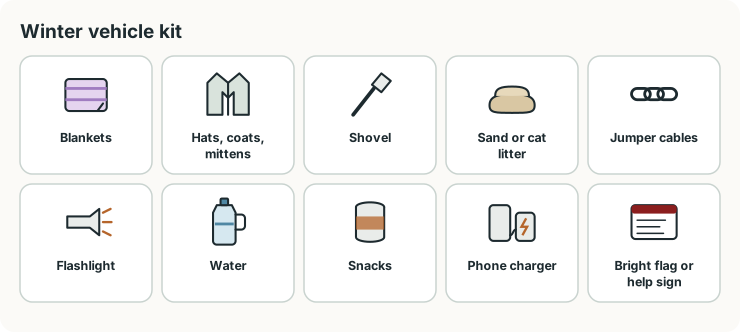
The checklist
Quantities come from the source cited beside them. † marks our packing suggestion where the official list gives no number.
| Item | How many | Why | |
|---|---|---|---|
| Blankets or sleeping bag | 1 per person | Red Cross winter driving list.[1] | |
| Rain gear, dry clothes, mittens, socks, wool hat | 1 set per person | Red Cross.[1] | |
| Newspapers (insulation) | A stack | Red Cross.[1] | |
| Plastic bags (sanitation) | A few | Red Cross.[1] | |
| Canned fruit, nuts, high-energy snacks | Per person | Red Cross.[1] | |
| Thermos of warm broth and bottled water | Per person | Red Cross.[1] | |
| Ice scraper, sand or cat litter, jumper cables | 1 each | Ready.gov car extras.[2] | |
| Bright red cloth | 1 | Trouble signal for the antenna.[1] | |
| Snow shovel (compact) | 1† | The Red Cross lists a snow shovel for home; avoid overexertion when shoveling.[1] |
Nice to have (not on the official lists)
Optional extras we think are useful. They are our suggestions, not agency recommendations.
| Item | How many | Why | |
|---|---|---|---|
| Traction mats | 1 pair | Help a stuck tire grip. Sand covers the official list. | |
| Hand warmers | A box | Small, cheap comfort for a long wait. |
Build it on a budget
Ready.gov suggests building a kit over time, starting with what you already have, and checking garage sales and thrift stores.[4] Tiers add up: each one builds on the one before. Dollar amounts are rough planning targets, not price quotes; prices vary.
$0 (Free: gather from home)
- Blankets, hats, gloves from home
- Bag of sand or cat litter
- Water and snacks
$50
- Ice scraper
- Small shovel
$150
- Jumper cables or jump starter
- Emergency blankets and hand warmers
$500
- Kit in every car
- Traction aids
Shop this list
Affiliate disclosure: the shopping links below are Amazon affiliate links. As an Amazon Associate we earn from qualifying purchases, at no extra cost to you. They are generic search links, not endorsements of a brand. Full disclosure.
These are generic Amazon searches, not picks of a specific brand. Compare ratings, check what fits your household, and buy only what you don’t already own. Most of this list can come from around your home.
Sources
- American Red Cross: Winter Storm Safety
- FEMA / Ready.gov: Car Safety
- FEMA / Ready.gov: Winter Weather
- FEMA / Ready.gov: Low and No Cost Preparedness
Official pages checked 14 November 2026. Guidance changes; follow your local officials first. How we research.
Page checked on · Change log · Report an error · Calm by design