Kit guide · Evacuation
Car emergency kit: what to keep in every vehicle
If you’re stranded, this is what gets you home or keeps you safe until help comes.
How to use this guide: follow the steps, tick off the checklist, then print it . The printout has no shopping links.
Stay-Go Guide · Car emergency kit: what to keep in every vehicle · Checked: ____________
What to do
- Start with a basic kit (water, food, flashlight, first aid kit) and add the car extras below. Ready.gov says to keep an emergency kit in your car in case you are stranded.[1]
- Use a sturdy bin or bag and keep one kit in each vehicle.[2]
- Plan for heat and cold. Be Ready Utah warns that car kits see temperature extremes, so only pack items that can take them, and rotate items more often.[2]
- Keep the tank full. Ready.gov says a full tank helps in an evacuation or outage and keeps the fuel line from freezing.[1]
- Get the car checked before an emergency: battery, brakes, lights and hazard lights, tires, wipers, heater and defroster.[1]
- Know the driving rules that save lives. Never drive through flooded areas. Ready.gov says six inches of water can cause a loss of control, and a foot of water will float many cars.[1] If a power line falls on your car, stay inside until a trained person removes it.[1]
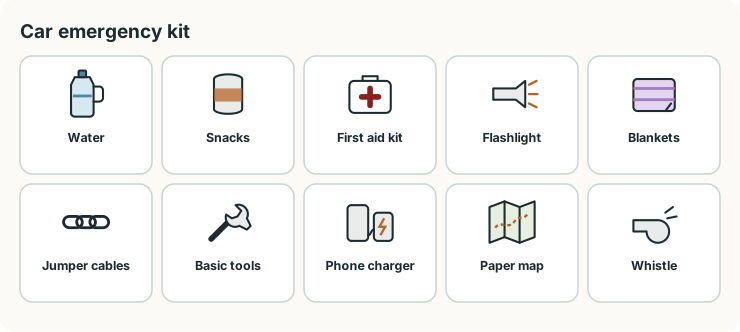
The checklist
Quantities come from the source cited beside them. † marks our packing suggestion where the official list gives no number.
| Item | How many | Why | |
|---|---|---|---|
| Jumper cables | 1 set | Ready.gov car extra.[1] | |
| Flares or reflective triangle | 1 set | So other drivers see you.[1] | |
| Car phone charger | 1 | Ready.gov car extra.[1] | |
| Blanket | 1 per seat† | Ready.gov car extra.[1] | |
| Map | 1 | In case GPS or service fails.[1] | |
| Cat litter or sand | 1 bag† | For tire traction.[1] | |
| Ice scraper | 1 | Ready.gov car extra.[1] | |
| Water | 1 gallon per person per day† | Ready.gov’s winter car kit includes bottled water.[3] In desert heat, carry more. | |
| Non-perishable snacks | A few days’ worth† | Ready.gov winter car kit.[3] | |
| Flashlight and batteries | 1† | Ready.gov winter car kit.[3] | |
| Warm clothes | 1 set per person† | Ready.gov winter car kit.[3] | |
| First aid kit | 1 | The Red Cross says to keep a first aid kit in your home and in your car.[4] |
Nice to have (not on the official lists)
Optional extras we think are useful. They are our suggestions, not agency recommendations.
| Item | How many | Why | |
|---|---|---|---|
| Portable jump starter | 1 | Lets you start the car without a second vehicle. Jumper cables still cover the official list. | |
| Tire inflator | 1 | Plugs into the car to top up a low tire. | |
| Tow strap and work gloves | 1 each | Handy for getting unstuck. Don’t overexert yourself. |
Southern Utah and hot weather
Never leave people or pets in a closed car on a warm day.[5] For winter driving, add the winter vehicle kit. For a full evacuation, pair this with a go bag for each person.
Build it on a budget
Ready.gov suggests building a kit over time, starting with what you already have, and checking garage sales and thrift stores.[6] Tiers add up: each one builds on the one before. Dollar amounts are rough planning targets, not price quotes; prices vary.
$0 (Free: gather from home)
- Old blanket
- Phone charger cable
- Water bottles
- Snacks
- Flashlight from home
$50
- Car phone charger
- Reflective triangle or flares
- Jumper cables
$150
- First-aid supplies
- Portable jump starter
- Small shovel
$500
- Kit for each household car
- Winter traction aids and a fuller winter kit
Shop this list
Affiliate disclosure: the shopping links below are Amazon affiliate links. As an Amazon Associate we earn from qualifying purchases, at no extra cost to you. They are generic search links, not endorsements of a brand. Full disclosure.
These are generic Amazon searches, not picks of a specific brand. Compare ratings, check what fits your household, and buy only what you don’t already own. Most of this list can come from around your home.
Sources
- FEMA / Ready.gov: Car Safety
- Utah DEM / Be Ready Utah: Get a Kit: Family
- FEMA / Ready.gov: Winter Weather
- American Red Cross: Anatomy of a First Aid Kit
- FEMA / Ready.gov: Extreme Heat
- FEMA / Ready.gov: Low and No Cost Preparedness
Official pages checked 14 November 2026. Guidance changes; follow your local officials first. How we research.
Page checked on · Change log · Report an error · Calm by design