Home / Topics / Light and power
Light and power · Guide
Cooking without power and storing fuel safely
Hot food is a comfort in an outage. The rules below keep it from becoming the emergency.
What this covers
How to eat well during an outage without risking carbon monoxide poisoning or a fire, and how to store the fuel safely. Carbon monoxide is an odorless, colorless gas that can kill without warning, and burning fuel in stoves, lanterns, grills, and small engines makes it.[1]
Why it matters
CDC says more than 400 Americans die each year from unintentional carbon monoxide poisoning not linked to fires.[1] Cooking is also the leading cause of home fires.[2]
When to use it
- A power outage longer than a few hours, once the fridge food is used or the safe time has passed (see food safety in an outage).
- Any time you would reach for a camp stove, grill, or generator.
How: the rules that keep you safe
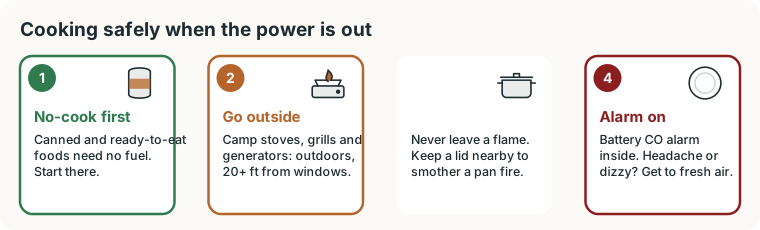
- Eat no-cook food first. Ready.gov suggests foods that need no refrigeration, preparation, or cooking.[3]
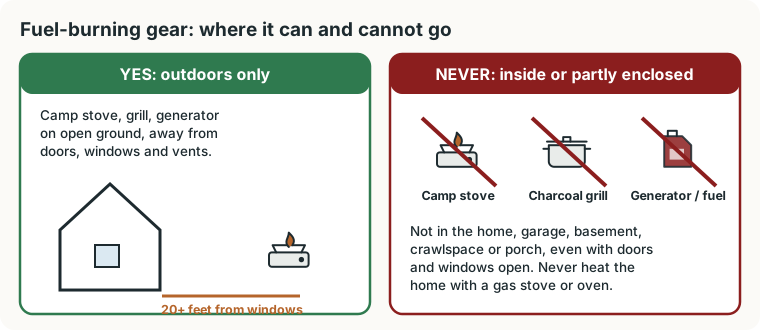
- Camp stoves and charcoal grills go outdoors only, in a well-ventilated area at least 20 feet from windows.[4]
- Never indoors, never partly enclosed. The Red Cross says never use a generator, grill, camp stove, or other gasoline, propane, natural gas, or charcoal-burning device inside a home, garage, basement, crawlspace, or any partially enclosed area.[5] CDC: never burn charcoal indoors, and never use a portable gas camp stove indoors.[1]
- Never heat your home with a gas stove or oven.[4][1]
- Stand by your pan. If you leave, turn the burner off. If you see smoke or the grease starts to boil, turn it off. Keep a lid or baking sheet nearby to cover a pan that catches fire.[2]
- Keep a battery CO alarm inside. CPSC: battery-operated or battery-backup CO alarms on every level and outside sleeping areas.[6] Symptoms are headache, dizziness, weakness, nausea, vomiting, sleepiness, and confusion; get to fresh air, then call 911.[6]
Fuel storage basics
The Red Cross gives these rules for generator fuel, and they apply to any fuel you keep for an outage:[5]
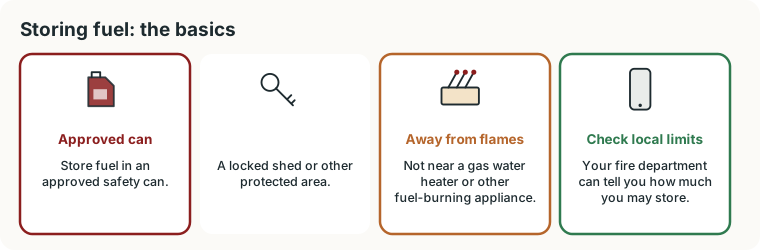
- Store fuel in an approved safety can, and use the fuel type the equipment calls for.
- Keep it outside living areas, in a locked shed or other protected area.
- Keep it away from fuel-burning appliances, such as a natural gas water heater in a garage.
- Local laws may limit how much fuel you can store, or where. Ask your local fire department.[5]
- Let engines cool before refueling. Fuel spilled on hot parts can ignite.[5]
We don’t publish a “how many gallons” figure because the official sources don’t give one; the limit is set locally.
Where to set up
On open ground outdoors, at least 20 feet from windows, doors, and vents, never in a garage, even with the door open.[1]
Gear
Our no-power cooking kit lists the stove, fuel, lighter, pot, CO alarm, and extinguisher. For carbon monoxide, read carbon monoxide safety.
Sources
- CDC: Carbon Monoxide (CO) Poisoning Basics
- U.S. Fire Administration: Cooking Fire Safety
- FEMA / Ready.gov: Food
- FEMA / Ready.gov: Power Outages
- American Red Cross: Safe Generator Use
- U.S. Consumer Product Safety Commission: Carbon Monoxide Information Center
Official pages checked 14 November 2026. Guidance changes; follow your local officials first. How we research.
Page checked on · Change log · Report an error · Calm by design