Kit guide · Food and nutrition
No-power cooking kit
Hot food during an outage, cooked outdoors, with the carbon monoxide rules built in.
How to use this guide: follow the steps, tick off the checklist, then print it . The printout has no shopping links.
Stay-Go Guide · No-power cooking kit · Checked: ____________
What to do
- Plan no-cook meals first. Ready.gov suggests non-perishable foods that need no refrigeration, preparation, or cooking.[1] See no-cook meals.
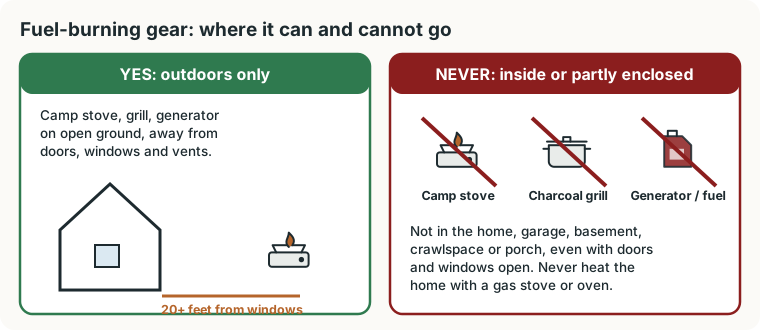
- Cook outdoors only. Camp stoves and charcoal grills go outdoors in a well-ventilated area at least 20 feet from windows.[2] CDC: never use a portable gas camp stove indoors, and never burn charcoal indoors.[3]
- Never in a garage, basement, crawlspace, or any partly enclosed area.[4] Never heat your home with a gas stove or oven.[2]
- Stand by your pan. If you leave, turn it off. Keep a lid or baking sheet nearby to smother a pan fire.[5]
- Store fuel safely. Approved safety cans, outside living areas, away from fuel-burning appliances, and ask your fire department about local limits.[4] Full guide: cooking without power and fuel storage.
The checklist
Quantities come from the source cited beside them. † marks our packing suggestion where the official list gives no number.
| Item | How many | Why | |
|---|---|---|---|
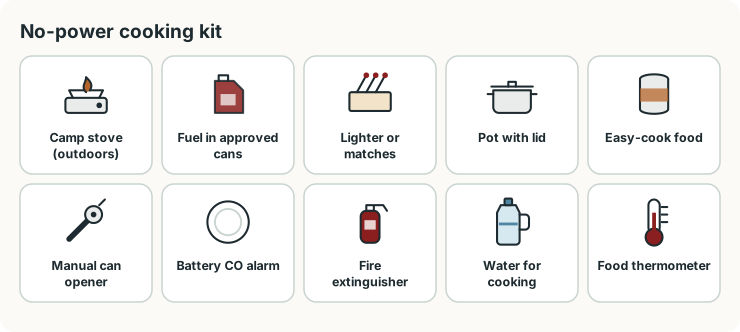
| Easy no-cook and quick-cook food | Enough for your planned meals† | Start with foods that need no cooking.[1] | |
| Manual can opener | 1 | Ready.gov basic kit item.[6] | |
| Camp stove for outdoor use | 1 | Outdoors only, 20+ feet from windows.[2] | |
| Fuel for that stove, in approved containers | Check local storage limits | Red Cross: approved safety can; local laws may limit how much you store.[4] | |
| Long lighter or waterproof matches | 1 set | CDC lists waterproof matches in its winter car kit.[7] | |
| Pot with lid | 1 | A lid smothers a pan fire.[5] Also used to boil water. | |
| Battery-operated carbon monoxide alarm | 1 per level and outside sleeping areas | CPSC: battery-operated or battery-backup CO alarms on every level and outside sleeping areas.[8] | |
| Fire extinguisher | 1 in the kitchen | See the home fire safety kit for how to choose one.[9] | |
| Food thermometer | 1 | Use it with the fridge and freezer rules. USDA: refrigerator 40 °F or below, freezer 0 °F or below.[10] | |
| Water for cooking and cleanup | On top of 1 gallon per person per day for drinking and sanitation | CDC baseline.[11] |
Nice to have (not on the official lists)
Optional extras we think are useful. They are our suggestions, not agency recommendations.
| Item | How many | Why | |
|---|---|---|---|
| Windscreen for the stove | 1 | Helps a camp stove work in wind outdoors. | |
| Heat-resistant gloves | 1 pair | For handling hot pots outside. |
Carbon monoxide has no smell. Symptoms include headache, dizziness, weakness, nausea, vomiting, sleepiness, and confusion. If you suspect CO poisoning, get outside to fresh air immediately, then call 911.[8]
Shop this list
Affiliate disclosure: the shopping links below are Amazon affiliate links. As an Amazon Associate we earn from qualifying purchases, at no extra cost to you. They are generic search links, not endorsements of a brand. Full disclosure.
These are generic Amazon searches, not picks of a specific brand. Compare ratings, check what fits your household, and buy only what you don’t already own. Most of this list can come from around your home.
Sources
- FEMA / Ready.gov: Food
- FEMA / Ready.gov: Power Outages
- CDC: Carbon Monoxide (CO) Poisoning Basics
- American Red Cross: Safe Generator Use
- U.S. Fire Administration: Cooking Fire Safety
- FEMA / Ready.gov: Build A Kit
- CDC: Preparing for a Winter Storm
- U.S. Consumer Product Safety Commission: Carbon Monoxide Information Center
- U.S. Fire Administration: Fire Extinguishers
- USDA Food Safety and Inspection Service: Keep Your Food Safe During Emergencies
- CDC: How to Create an Emergency Water Supply
Official pages checked 14 November 2026. Guidance changes; follow your local officials first. How we research.
Page checked on · Change log · Report an error · Calm by design