Water · How-to
How to boil water to make it safe
The most reliable way to kill germs in water when you have fuel and a safe place to heat it.
Safety numbers are quoted, not invented. Every dose, time, temperature, and ratio on this page is copied from the agency named beside it. Where agencies differ, we show each one with its source instead of picking. If your local health department or officials give different instructions, follow them.
Boiling is the method official sources rank first. CDC calls it the best way to kill germs in water[1], and Ready.gov calls it the safest method of treating water.[2] It kills bacteria, viruses, and protozoa.[3]
What you need
- A pot or kettle, a heat source you can use safely (camp stoves and grills belong outdoors only)
- Clean cloth, paper towels, or coffee filters if the water is cloudy
- Clean containers with tight covers for storing the boiled water
Ready.gov says charcoal grills and camp stoves are for outdoor use only.[4]
Steps
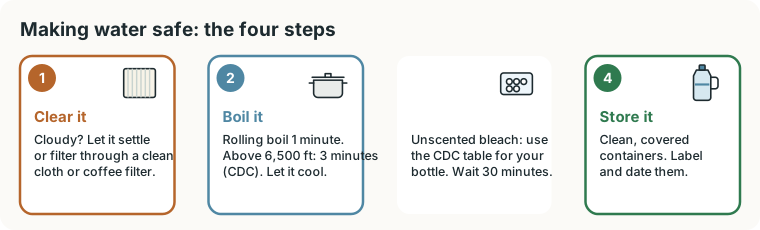
- If the water is cloudy, clear it first. Filter it through a clean cloth, paper towel, or coffee filter, or let it settle and draw off the clear water.[1]
- Bring the water to a rolling boil and keep it there. See the table below for how long. Some water will evaporate.[2]
- Let it cool before drinking. EPA says to let it cool naturally.[3]
- Store it in clean, sanitized containers with tight covers.[1]
How long to boil: the agencies differ at altitude
| Source | Boil time | At higher elevation |
|---|---|---|
| CDC[1] | Rolling boil for 1 minute | Above 6,500 feet: 3 minutes |
| EPA[3] | Rolling boil for at least one minute | Above 5,000 feet (1,000 meters): three minutes |
| Ready.gov[2] | Rolling boil for one full minute | No altitude adjustment given |
If your home sits between 5,000 and 6,500 feet, EPA says 3 minutes and CDC says 1. Boiling for 3 minutes meets both. Southern Utah spans low desert to high mountain country[5], so check your own elevation. NCHFP keeps a list of elevation lookup tools: Find Your Elevation.
Make it taste better
Boiled water tastes flat. To improve it, pour it back and forth between two clean containers and let it stand for a few hours, or add a pinch of salt to each quart or liter.[1][3]
What boiling will not do
- It does not remove heavy metals, salts, or most other chemicals.[3]
- You cannot make water that contains fuel, toxic chemicals, or radioactive material safe by boiling or disinfecting it. Use bottled water or another source and contact your health department.[1]
Out of fuel, or can’t boil? See disinfecting water with bleach and filters, tablets, and other methods.
Sources
- CDC: How to Make Water Safe in an Emergency
- FEMA / Ready.gov: Water
- U.S. EPA: Emergency Disinfection of Drinking Water
- FEMA / Ready.gov: Food
- Washington County, Utah: Emergency Management
- National Center for Home Food Preservation: Find Your Elevation
Official pages checked 14 November 2026. Guidance changes; follow your local officials first. How we research.
Page checked on · Change log · Report an error · Calm by design